Industrial Caster Selection Guide for Lean Manufacturing
Written by: Nicole Reps, Sales & Marketing of Flex Craft
When implementing lean manufacturing principles, every component of your workstation or material handling cart matters—including the casters. After all selecting the right industrial caster improves ergonomics, reduces operator fatigue, protects equipment, and increases productivity throughout your facility.
When building a mobile workstation, flow rack, tugger cart, or material handling solution with the Flex-Craft modular building system, choosing the proper caster is just as important as selecting the right frame.
Lean manufacturing focuses on eliminating waste while maximizing value. Mobile workstations and carts allow manufacturers to:
- Reconfigure production lines quickly
- Support continuous improvement (Kaizen)
- Reduce unnecessary walking and material handling
- Improve workplace ergonomics
- Adapt work cells without costly fabrication
However, even the best-designed mobile equipment can fall short if the casters are not matched to the application. A poorly selected caster can increase push force, damage flooring, create safety hazards, or limit the usefulness of otherwise well-designed equipment.
1: Determining Your Load Capacity
The first consideration should always be load capacity. Calculate by adding the weight of the cart or workstation and the maximum payload, this gives you the total load. Divide total load by the number of casters, then include an appropriate safety factor because loads are rarely distributed perfectly. Selecting a caster rated above the calculated load improves durability and accounts for uneven loading during normal operation.
Unit Weight + Max Payload = Total Load / # of Casters = lbs. per caster minimum
For example:
- Cart weight: 180 lbs.
- Product weight: 620 lbs.
- Total load: 800 lbs.
- Caster count : 4
180 + 620 = 800 ÷ 4 = 200 lbs. per caster minimum.
2: Matching the Caster to the Application
Different manufacturing applications require different caster styles.
Expandable casters insert directly into Flex-Craft’s 1″ × 1″ tubing and lock securely by expanding a rubber collar inside the tube. Installation requires only a standard wrench, making them ideal for modular equipment that may be reconfigured in the future. Ideal applications include:
- 5S shadow boards
- lightweight mobile workstations
- small assembly stations
- visual management displays
For facilities operating on sealed concrete floors Flex-Craft’s 3-inch Gray Donut Expandable Caster provides a durable, low-maintenance solution with a 300 lbs. per caster and is available with or without an integrated brake.
Plate Casters are for heavier-duty applications, as they provide maximum strength by bolting directly to Flex-Craft tubing using the Direct Bolt Joint system, creating a rigid connection suitable for:
- Heavy-duty carts
- Mobile flow racks
- Tugger carts
- Large assembly workstations
- Material handling equipment
Flex-Craft offers:
- 5-inch Plate Casters rated at 500 lbs. per caster
- 6-inch Plate Casters rated at 600 lbs. per caster
With swivel, rigid and side brake configurations, designers are able to optimize maneuverability for each application.


3: Floor Conditions
The type of flooring has a significant impact on caster performance.
Smooth Concrete Floors allow polyolefin wheels roll easily with low rolling resistance and require little maintenance, making them ideal for clean manufacturing environments.
General Manufacturing Floors where there may be more dust or debris present the gray rubber casters provide quiet operation with better shock absorption over small debris with improved traction. Rubber casters are often preferred for assembly workstations and mobile production equipment where operator comfort is important.
4: Choose Swivel, Rigid, or Both
Most industrial carts use a combination of caster styles. Combining two swivel casters with two rigid casters balance steering control with directional stability.
Swivel Casters best for:
- Tight turning
- Frequent direction changes
- Operator maneuverability
Rigid Casters best for:
- Straight-line travel
- Long transport distances
- Improved tracking
5: Don’t Forget Brakes
Lean manufacturing emphasizes repeatability and safety. Braked casters prevent workstations from moving during assembly operations while still allowing mobility when production layouts change.
Flex-Craft offers integrated brake option to every style of caster, making any caster set an excellent choice for ergonomic workstations that occasionally need repositioning.
6: Design the Frame for the Load
Caster selection is only part of the equation. The supporting structure must also safely handle expected loads. The Flex-Craft’s patented Direct Bolt Joint automatically squares the framework during assembly while creating one of the strongest modular connections available. As a result of using this joint on outside corners provides maximum structural integrity while squaring the frame.
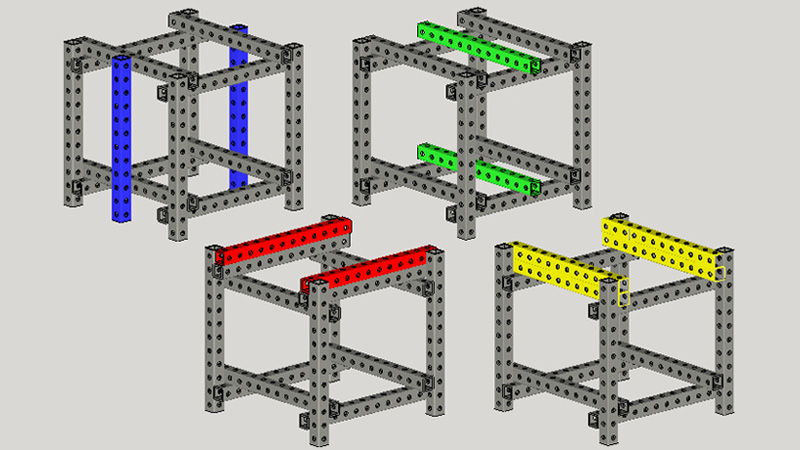
When additional strength is required, we recommend:
- Adding vertical supports
- Adding horizontal supports
- Doubling structural tubes
- Incorporating 1″ × 2″ tubing for higher load applications
These design techniques help distribute weight more effectively and increase overall system capacity.
7: Consider Future Flexibility
One of the greatest advantages of modular construction is adaptability. This flexibility supports continuous improvement initiatives while extending equipment life. Unlike welded equipment, Flex-Craft systems allow manufacturers to:
- Replace worn casters
- Upgrade to higher-capacity wheels
- Convert stationary equipment into mobile workstations
- Modify layouts without replacing the entire structure
8: When Stationary Equipment Is the Better Choice
Finally, not every workstation should roll.
For fixed assembly stations, inspection tables, or permanent production cells, Flex-Craft offers universal footers and telescoping footers that provide excellent stability while maintaining the same modular construction philosophy.
The telescoping footer also allows ergonomic height adjustment, making it ideal for multi-operator workstations.


In conclusion Industrial caster selection is about much more than simply choosing wheels. The right combination of load capacity, wheel material, mounting style, and mobility directly affects productivity, ergonomics, and workplace safety.
Flex-Craft’s modular system makes it easy to build workstations, carts, flow racks, and material handling equipment that evolve alongside your manufacturing process. By pairing the proper caster with a structurally sound frame, manufacturers can create flexible, durable solutions that support lean manufacturing for years to come.
Looking to build a custom lean manufacturing solution? Explore Flex-Craft’s complete line of modular tubing, brackets, casters, and workstation components at https://flex-craft.com/.